Article Brief
Learn the risks and penalties of accepting cash loans or deposits. Stay compliant and avoid legal trouble!
In today’s digital age, transparency in financial transactions is paramount, and cash dealings in large sums are heavily scrutinized. The Income-tax Act, through Section 269SS, aims to curb the acceptance of loans or deposits in cash, reducing the scope for tax evasion and ensuring that financial transactions are documented.
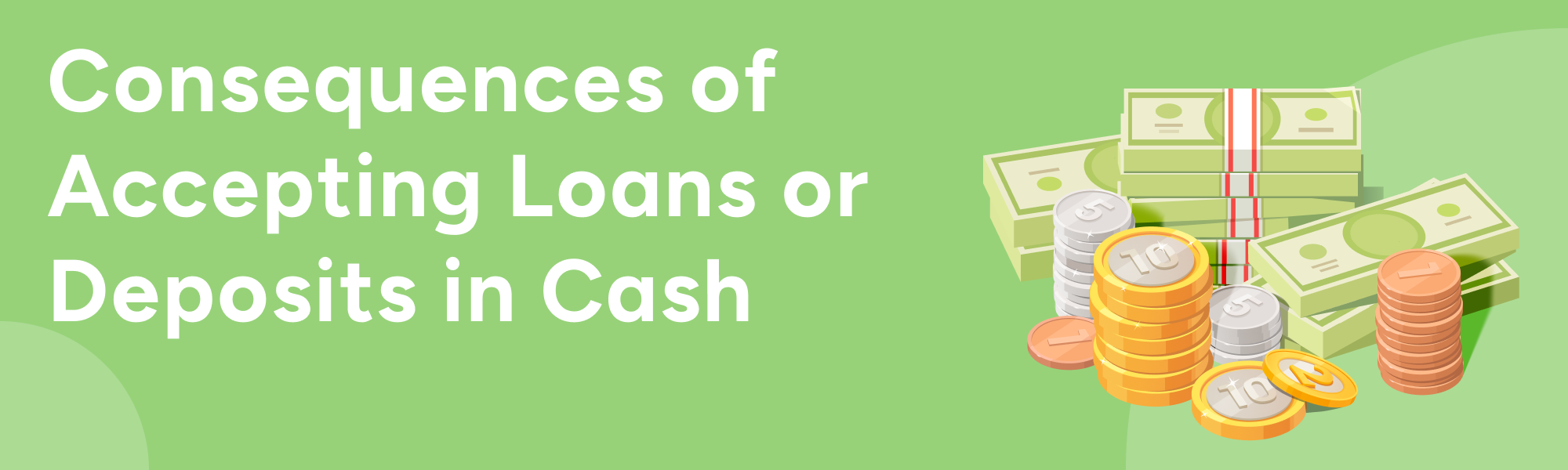
This article explores the implications of violating Section 269SS by accepting loans or deposits in cash and the penalties under Section 271D.
Restrictions on Cash Loans/ Deposits:
Section 269SS of the Income-tax Act prohibits any person (subject to certain exceptions) from accepting loans or deposits in cash if the amount exceeds ₹20,000. Such transactions are required be conducted through account payee cheque, account payee bank draft, electronic clearing system (ECS), or any other prescribed electronic mode.
The section further clarifies three key conditions that trigger the cash transaction limit:
- Individual or Aggregate Amount of Loan/Deposit: If the loan, deposit, or specified sum exceeds ₹20,000.
- Outstanding Amount: If the total of earlier loans or deposits from the same person that remain unpaid, together with the new loan, exceeds ₹20,000.
- Combined Limit: If the combined total of the current loan and unpaid previous loans exceeds ₹20,000.
In any of the above situations, the transaction has to be conducted through specified modes only. Failure to do so can attract penalty equal to the amount of loan or advance taken.
Exceptions to Section 269SS
There are certain exceptions where Section 269SS does not apply:
- Transactions with the Government, banks (including cooperative banks), post office savings banks, or corporations established by government acts.
- Loans or deposits accepted by or from government companies or certain notified institutions.
- Transactions between two parties who both derive agricultural income and do not have taxable income under the Income-tax Act.
- Loans and deposits involving primary agricultural credit societies or co-operative agricultural and rural development banks, where the cash limit is relaxed to ₹2,00,000.
Penalty Under Section 271D: Non-Compliance Consequences
If any person accepts a loan or deposit, violating the provisions of Section 269SS, they are liable for a penalty under Section 271D. The penalty equals the amount of the loan or deposit accepted in cash.
For instance, if a person accepts a loan of ₹50,000 in cash, contrary to Section 269SS, they will face a penalty of ₹50,000.
Key Implications of Accepting Loans in Cash
- Severe Penalty: The penalty under Section 271D is stringent, with the defaulter liable to pay an amount equal to the loan or deposit accepted in cash.
- Lack of Legal Recourse: The penalty under Section 271D is mandatory and leaves little room for exemption, except in cases where the taxpayer can prove a reasonable cause for non-compliance..
- Potential Scrutiny by Tax Authorities: Large cash transactions tend to attract scrutiny from tax authorities. Even if the source of funds is legitimate, the use of cash can create doubt about the transparency of the transaction. This could lead to further investigation into the taxpayer's finances.
Conclusion:
Section 269SS is an important provision aimed at curbing the use of cash in large financial transactions. Violating this provision by accepting loans or deposits in cash can lead to significant penalties under Section 271D, equal to the amount involved in the transaction. To avoid such penalties, it is crucial to stay compliant with the law by conducting transactions through legitimate banking channels. As financial regulations evolve, taxpayers must remain vigilant and ensure that all high-value transactions are transparent, well-documented, and in line with the law.
Prosperr.io is a simple platform to manage your personal income tax. It helps you save and automates tax tasks. It gives you the knowledge to make smart financial choices, keeping your money where it belongs.
Click here to book your FREE tax assessment call
Disclaimer:
This article is based on my personal understanding of the relevant provisions of the Income-tax Act and should not be construed as professional advice. Please consult a tax professional for specific guidance.