Article Brief
Clarify tax deductions with a breakdown of Section 24B, 80EE, and 80EEA for better financial planning and savings. Dive into the details here.
Tax season can feel like being lost in a jungle, especially when it comes to understanding how to maximize benefits on your housing loan repayments. Sections 24b, 80EE, and 80EEA of the Indian Income Tax Act are like guiding stars, offering tax benefits for those repaying home loans.
In this article, we will see the differences between three important sections of the Income Tax Act: 24b, 80EE, and 80EEA, focusing on deductions on interest paid on housing loans under the Old and New Tax Regimes.
Section 24B: Mortgage Interest Deduction
One of the key provisions under Section 24b of the Income Tax Act allows taxpayers to claim deductions on the interest paid towards their housing loan. This deduction is applicable to both self-occupied and let-out residential houses. Here's how it works:
- Deduction Limit: For self-occupied properties, the maximum deduction allowed is ₹2 lakhs per annum. However, when you rent out a property, there is no upper limit on the deduction.
- Conditions: To avail of this deduction, the loan must be taken for the purpose of purchasing or constructing a residential property, and the construction must be completed within five years from the end of the year the loan was taken out.
Section 80EE: First-Time Homebuyers
Section 80EE of the Income Tax Act provides additional benefits to first-time homebuyers. Here's a breakdown:
- Eligibility: Only individuals who are first-time homebuyers and whose loan was sanctioned between April 1, 2016, and March 31, 2017 by the prescribed financial institutions are eligible for this deduction.
- Deduction Limit: The maximum deduction allowed under this section is ₹50,000 per annum; however, the amount of interest allowed as deduction under this provision, cannot be claimed as a deduction under any other provisions of the Income-tax Act.
- Loan Amount Limit: The loan amount should not exceed ₹35 lakhs, and the value of the residential property should not exceed ₹50 lakhs.
Section 80EEA: Affordable Housing
Introduced to promote affordable housing, Section 80EEA of the Income Tax Act offers additional tax benefits. Here's what you need to know:
- Eligibility: Individuals who have taken a loan sanctioned between April 1, 2019, and March 31, 2022, from the prescribed financial institutions and who are not eligible for deduction under section 80EE.
- Deduction Limit: The maximum deduction allowed under this section is ₹1.5 lakhs; however, the amount of interest allowed as deduction under this provision cannot be claimed as deduction under any other provisions of the Income-tax Act.
- Affordable Housing Criteria: The stamp duty value of the residential property should not exceed ₹45 lakhs, and the individual should not own any other residential property on the date of the sanction of the loan.
A Comparative Analysis
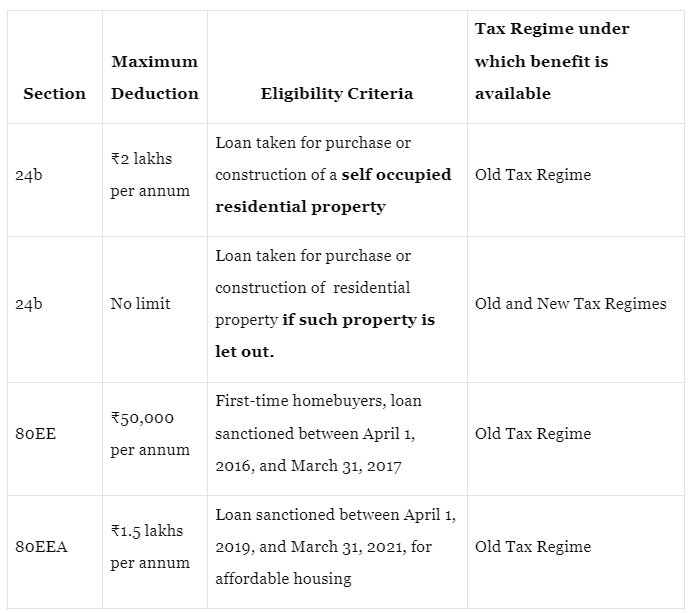
Let's summarize the eligibility of the deduction, subject to the fulfillment of conditions prescribed:-
Conclusion
Understanding Sections 24B, 80EE, and 80EEA is crucial for maximizing housing loan tax benefits. Whether you're a first-time homebuyer or purchasing an affordable house, leveraging these provisions can significantly reduce your tax liability and make homeownership more affordable.
Click here to book your FREE tax assessment call
Disclaimer:
The article is only for educational purposes and is not to be construed as tax advice. The relevant provisions of the Income-tax Act may be referred to, for complete understanding.