Article Brief
Explore the key differences between Belated, Revised, and Updated Returns for smarter tax filing.
Click here to book your FREE tax assessment call When it comes to filing Income Tax Returns (ITR), taxpayers are provided with several options depending on their situation. While timely filing is always encouraged, the Income-tax Act offers provisions for those who either miss the due date, discover errors in their returns, or need to disclose additional income after the original filing. These provisions include Belated Return, Revised Return, and Updated Return. Understanding the differences between these returns is crucial for ensuring compliance with tax laws and avoiding penalties.
1. Belated Return: Section 139(4):
A Belated Return is applicable when a taxpayer misses the original due date for filing their ITR as prescribed under Section 139(1). In such cases, the taxpayer can still file their return late, but they must do so within a specified time frame:
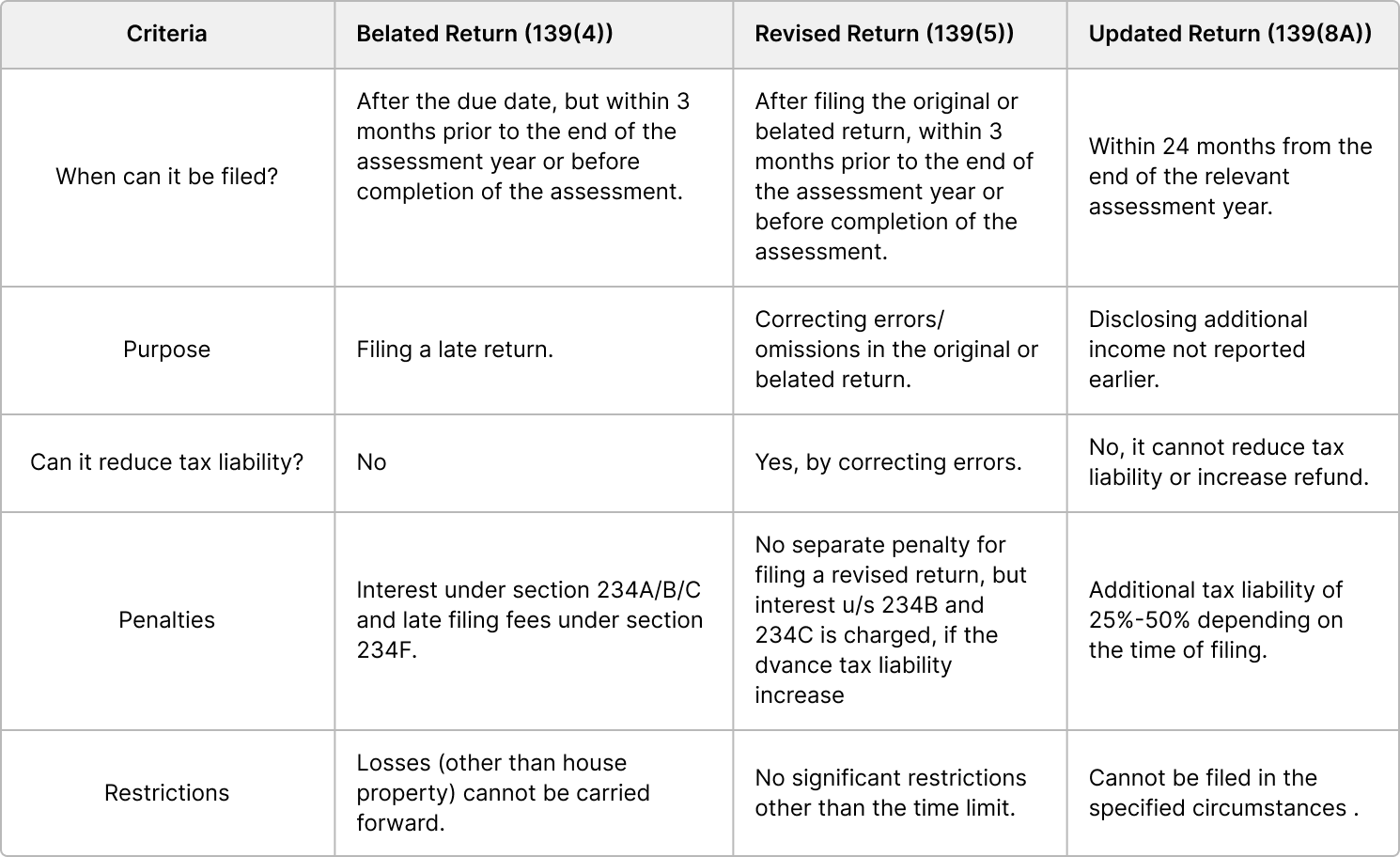
- A belated return can be filed three months prior to the end of the relevant assessment year or before the completion of the assessment, whichever is earlier.
For instance, for the assessment year 2024-25, the last date for filing a belated return would be December 31, 2024, unless the assessment is completed earlier.
Key Points:
- A belated return attracts interest and fee for late filing.
- Losses under from business or profession and capital gains cannot be carried forward if the return is belated.
2. Revised Return: Section 139(5):
A Revised Return allows a taxpayer who has already filed their return (whether on time under Section 139(1) or belatedly under Section 139(4)) to correct any omissions or errors discovered after the return was filed. This provides an opportunity to rectify mistakes without facing significant consequences.
- A revised return can be filed three months prior to the end of the relevant assessment year or before the completion of the assessment, whichever is earlier.
For example, for the assessment year 2024-25, a taxpayer can file a revised return up until December 31, 2024, unless the assessment is completed sooner.
Key Points:
- The revised return replaces the original or belated return, and the most recent return is considered for assessment.
- There is no limit on how many times a taxpayer can revise their return before the deadline.
3. Updated Return: Section 139(8A):
Introduced to encourage voluntary compliance, an Updated Return provides an option for taxpayers to disclose previously undeclared income, even if they missed filing the original return or failed to include certain income in their earlier filings. This provision offers a broader window but comes with certain restrictions.
- An updated return can be filed within 24 months from the end of the relevant assessment year.
For instance, for the assessment year 2024-25, an updated return can be filed up until March 31, 2027.
An Updated Return provides an opportunity for taxpayers to voluntarily disclose additional income. However, the in the circumstances mentioned below, filing of an updated return is not allowed.
(i) If the updated is a return of loss: An updated return cannot be filed if it is a return showing a loss for the relevant assessment year.
(ii) If it decreases the total tax liability: The updated return cannot be filed if it reduces the total tax liability determined based on the return previously filed under Section 139(1), 139(4), or 139(5).
(iii) If it results in a refund or increases the refund: The updated return cannot be filed if it leads to a refund or increases the refund that was due based on the original, belated, or revised return.
(iv) If a search has been initiated under Section 132: An updated return cannot be filed if a search has been conducted under Section 132 in the case of the taxpayer for the assessment year relevant to the previous year in which the search was initiated and any assessment year preding to that year.
(v) If books, documents, or assets have been requisitioned under Section 132A: If assets, books of accounts, or other documents have been requisitioned under Section 132A, for the assessment year relevant to the previous year in which the requisition was made and any assessment year preding to that year.
(v) If a survey has been conducted under Section 133A (excluding subsection (2A): An updated return cannot be filed if a survey under Section 133A (except subsection (2A)) has been conducted in the taxpayer's case for the assessment year relevant to the previous year in which the survey was conducted and any assessment year preding to that year.
(vi) If the taxpayer has received a notice regarding assets or documents under Section 132 or 132A: If the taxpayer receives a notice stating that assets or documents seized or requisitioned under Section 132 or 132A from another person belong to him for the assessment year relevant to the previous year in which the search was initiated, requisition was made and any assessment year preding to that year.
(vii) If any assessment, reassessment, recomputation, or revision proceedings are pending or completed: If any proceedings for assessment, reassessment, recomputation, or revision of income for the relevant assessment year are pending or completed, the taxpayer is not eligible to file an updated return.
(viii) If the Assessing Officer has specific information under various Acts: If the Assessing Officer has specific information under any of the following laws and which has been communicated to the taxpayer before filing the updated return, the updated return cannot be filed:
- Smugglers and Foreign Exchange Manipulators (Forfeiture of Property) Act, 1976
- Prohibition of Benami Property Transactions Act, 1988
- Prevention of Money-laundering Act, 2002
- Black Money (Undisclosed Foreign Income and Assets) and Imposition of Tax Act, 2015
(ix) If information under Section 90 or 90A has been received: An updated return cannot be filed if any information for the relevant assessment year received under the DTAA (Section 90 or 90A) and such information has been communicated before filing the updated return.
(x) If prosecution proceedings have been initiated under Chapter XXII: If prosecution proceedings have already been initiated against the taxpayer for the relevant assessment year under Chapter XXII of the Income-tax Act.
(xi) If an updated return for the same assessment year has already been filed: If the taxpayer has already filed an updated return for the relevant assessment year, he cannot file another updated return for the same year.
(xii) If the taxpayer belongs to a notified class of persons: If the taxpayer or class of persons is notified by the Board as ineligible for filing an updated return, then such persons cannot file an updated return.
Additional tax to be paid:
- Filing an updated return involves paying additional tax in the form of a penalty, which increases with time (25% of the tax and interest if filed within 12 months from the end of the assessment year , 50% if filed after 12 months but within 24 months from the end of the assessment year ).
- Updated returns cannot be filed for reducing tax liability or claiming refunds.
5. Comparison of Belated, Revised, and Updated Returns:
Conclusion:
Understanding the difference between Belated, Revised, and Updated Returns is essential for making informed decisions about tax compliance. While filing a return within the due date is always preferable, these provisions provide flexibility for those who miss the deadline, discover errors, or need to declare additional income later. However, taxpayers must be mindful of the respective, interest, penalties and limitations that come with each option.
Prosperr.io is a simple platform to manage your personal income tax. It helps you save and automates tax tasks. It gives you the knowledge to make smart financial choices, keeping your money where it belongs.
Click here to book your FREE tax assessment call
Disclaimer:
The information provided in this article is for general informational purposes only and does not constitute legal, tax, or professional advice. Readers are advised to consult with a qualified tax advisor or legal professional for specific advice tailored to their individual circumstances, particularly regarding reassessment proceedings and claiming refunds. The author and publisher are not responsible for any errors or omissions, or for any actions taken based on the content of this article.