Article Brief
Confused by non-tax revenue? Explore how governments earn beyond taxes & their impact on your life. Learn its benefits, challenges & more.
While taxes are the most well-known source of government income, there is a lesser-known counterpart - non-tax revenue. But what exactly is non-tax revenue? How does it work, and why is it important?
What is Non-Tax Revenue?
Non-tax revenue refers to the income generated by the government outside of traditional tax collection methods like income tax, sales tax, and property tax. It encompasses a wide range of sources, and understanding these categories is crucial to grasping the bigger picture.
Examples of Non-Tax Revenue
The landscape of non-tax revenue is vast and varied and here are some examples of non-tax revenue:
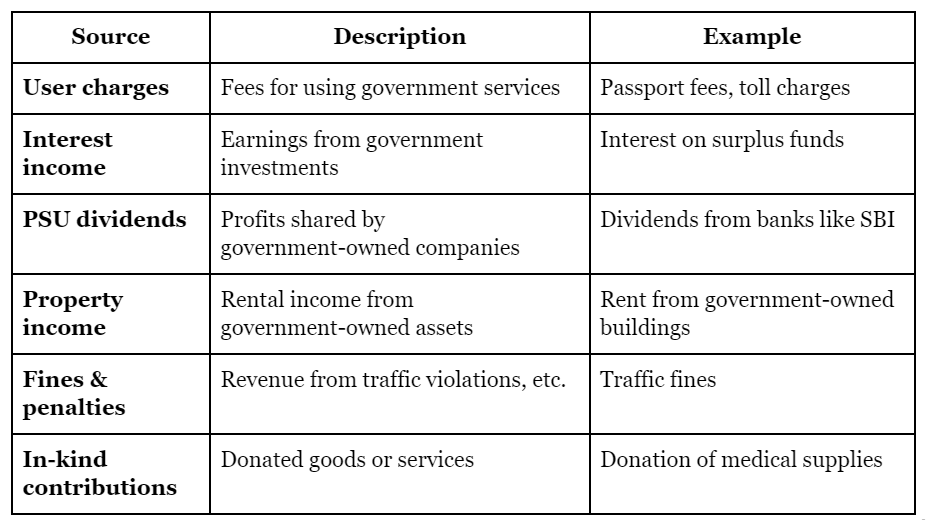
- User charges: Think of fees levied for public services like passport applications, toll roads, or usage charges for government facilities like swimming pools or libraries.
- Interest income: Governments often invest surplus funds, and the interest earned on these investments contributes to non-tax revenue.
- Dividends from public sector undertakings (PSUs): When PSUs, like banks or energy companies, generate profits, a portion of those profits are shared with the government as dividends.
- Income from property: Rental income from government-owned properties like land or buildings falls under this category.
- Fines and penalties: Revenue collected from traffic fines, parking violations, or other penalties imposed by the government adds to the non-tax kitty.
- In-kind contributions: Donated goods or services from individuals or organizations can be considered non-tax revenue.
Table 1: Breakdown of Non-Tax Revenue Sources in India
It's important to note that the specific mix of non-tax revenue sources can vary depending on the country's economic structure and government policies.
How Does Non-Tax Revenue Work?
The mechanism behind non-tax revenue generation differs based on the source. Here's a breakdown of how some common examples work:
- User charges: When you pay a fee for a government service, that money directly contributes to non-tax revenue.
- Interest income: The government invests funds in various instruments like bonds, and the interest earned is added to the non-tax revenue pool.
- PSU dividends: Public Sector Undertakings (PSU) operate commercially, and a portion of their profits are distributed to the government as dividends.
In essence, non-tax revenue generation involves activities where the government acts as a service provider, investor, or asset owner, and earns income through those endeavors.
Benefits of Non-Tax Revenue
Non-tax revenue offers several advantages for governments:
- Reduced reliance on taxes: A diversified revenue stream helps governments lessen their dependence on taxes, potentially leading to lower tax burdens for citizens.
- Funding for specific initiatives: Non-tax revenue can be earmarked for specific projects or social programs, ensuring dedicated resources for priority areas.
- Improved infrastructure: User charges collected for toll roads or utilities can be reinvested in infrastructure development, benefiting the public.
Ultimately, a healthy level of non-tax revenue can contribute to a government's fiscal stability and its ability to deliver essential services to its citizens.
Challenges of Non-Tax Revenue
While non-tax revenue presents advantages, there are also challenges to consider:
- Inequity: User charges can disproportionately burden low-income earners who rely on public services.
- Over-reliance on certain sources: Excessive dependence on specific non-tax revenue sources, like PSU dividends, can make the government vulnerable to fluctuations in those sectors.
- Transparency concerns: There might be a lack of transparency in how non-tax revenue is collected and spent, raising accountability issues.
Is Non-Tax Revenue Good or Bad?
The impact of non-tax revenue is a subject of ongoing debate. Here's a breakdown of different perspectives:
- Supporters:
- Promotes economic activity: User charges for services like toll roads can incentivize private investment in infrastructure development.
- Encourages responsible use: Charging for services can discourage overuse and promote responsible utilization of public resources.
- Flexibility: Non-tax revenue provides governments with more flexibility in managing their finances, allowing them to react to changing economic conditions.
- Critics:
- Burden on citizens: Excessive reliance on user charges can create an additional financial burden on citizens, especially those who rely heavily on public services.
- Reduced accountability: Non-tax revenue sources might be less accountable to public scrutiny compared to tax collection.
- Inefficiency: Inefficient management of government-owned assets or services can lead to lower non-tax revenue generation.
Non-tax revenue can be a valuable tool for governments, but it needs to be managed responsibly and transparently to ensure it benefits all citizens, not just a select few.
Who Collects Non-Tax Revenue?
The responsibility of collecting non-tax revenue falls on various entities, depending on the source:
- Government departments: Departments like the transport department collect user charges for services like passport applications or toll roads.
- Public sector undertakings (PSUs): PSUs are responsible for remitting dividends to the government.
- Investment authorities: Government bodies managing surplus funds are responsible for earning interest income on those investments.
Ultimately, the collected non-tax revenue is deposited into the government's treasury and used to finance various public expenditures.
How is Non-Tax Revenue Spent?
Understanding how non-tax revenue is spent is crucial for ensuring transparency and accountability. Here's a glimpse into the spending landscape:
- General government expenditure: Non-tax revenue can be used to fund various government programs in areas like education, healthcare, and infrastructure development.
- Debt repayment: A portion of non-tax revenue might be allocated towards repaying government debt.
- Investment in public assets: Revenue can be reinvested in improving existing government assets or developing new ones.
The Indian government typically outlines the budget allocation for non-tax revenue in its annual budget report.
Impact of Non-Tax Revenue
Non-tax revenue has a significant impact on various aspects of a nation's well-being:
- Economic growth: User charges for infrastructure projects can promote economic activity and job creation.
- Social development: Non-tax revenue can be used to fund social programs that improve the lives of citizens, particularly those in vulnerable sections of society.
- Fiscal stability: A diversified revenue stream contributes to a government's fiscal stability, allowing it to weather economic downturns more effectively.
By effectively managing non-tax revenue, governments can create a more prosperous and equitable future for their citizens.
Conclusion
Non-tax revenue is a complex but crucial aspect of government finances. Understanding its sources, mechanisms, and impact is essential for informed public discourse and responsible government policy. By harnessing the potential of non-tax revenue while mitigating its challenges, governments can create a more sustainable and equitable future for all. Book a free wealth consultation call today
(Disclaimer- The information in this blog is for informational purposes only and should not be considered financial advice. Please consult a professional for personalized guidance on matters related to taxes or financial planning.)